Tag: National Parks

  • Ranger PamPaw’s Guide

    Chiricahua National Monument

    Arizona’s Wonderland of Rocks

    Willcox, Arizona  ·  Dos Cabezas Mountains  ·  Est. 1924

    ▶ A Note from Ranger PamPaw

    “Chiricahua stops people in their tracks. There’s nowhere else in the park system quite like it.”

    Welcome to Arizona’s Wonderland of Rocks — a sky-island landscape of volcanic pinnacles, balanced rocks, and deep natural and cultural history. This guide supplements our First Encounters episode on Chiricahua, offering everything you need to plan your own visit.

    Few national monument units reward a slow visit more than this one. The drive in, the hike through the formations, the quiet of the campground at night — Chiricahua is the kind of place that earns a return trip before you’ve even left.

    — Ranger PamPaw

    ▶ Quick Facts

    DesignationNational Monument
    EstablishedApril 18, 1924 — to protect the volcanic rock formations and cultural history of the Dos Cabezas Mountains
    Location12856 E Rhyolite Creek Rd, Willcox, AZ 85643 — southeastern Arizona, ~120 miles east of Tucson
    Size11,985 acres within the Coronado National Forest
    Why It’s FamousThousands of rhyolite rock pinnacles, balanced rocks, and spires known as the “Wonderland of Rocks”
    AdmissionFree — no entrance or parking fees
    Visitor Center HoursOpen daily 8:30 a.m. – 4:30 p.m.; closed Christmas Day — check nps.gov/chir for seasonal updates
    Trails17+ miles of maintained trails; Echo Canyon Loop (3.3 mi), Heart of Rocks Loop (7 mi), Massai Point Nature Trail (0.5 mi)
    CampgroundBonita Canyon — 23 sites, reservation-only via recreation.gov; vehicle length limit typically 29 feet
    PetsLeashed pets permitted in parking areas and on the Bonita Canyon Drive; not permitted on trails
    NPS Websitenps.gov/chir

    ▶ How the Wonderland of Rocks Was Made

    The Turkey Creek Caldera

    Approximately 27 million years ago, a massive volcanic eruption — centered on what geologists now call the Turkey Creek Caldera — blanketed this region of southeastern Arizona in a thick layer of ash and volcanic debris. That material compressed and hardened over millions of years into rhyolite tuff, a relatively soft volcanic rock. Then erosion went to work: water, frost, and wind slowly carved the tuff into the improbable landscape visible today — columns, spires, balanced rocks, and pinnacles that seem to defy gravity at every turn.

    The formations are concentrated in the upper reaches of Bonita Canyon, where the geology produced the densest and most dramatic clustering of pinnacles in the monument. This is the heart of what visitors and writers have long called the Wonderland of Rocks — a name that understates the place just enough to let the reality of it land as a genuine surprise.

    The Sky Islands

    Chiricahua sits within one of the most ecologically rich corners of North America — the Sky Islands of southeastern Arizona and northern Mexico. These isolated mountain ranges rise dramatically from the surrounding desert, each one functioning as an ecological island. The elevation gradient within the Chiricahua Mountains alone spans desert scrub at the base to pine, fir, and Douglas-fir forest at the upper elevations, supporting a remarkable diversity of plant and animal life compressed into a relatively small area. Rare birds, including elegant trogons and sulfur-bellied flycatchers, draw birders from across the country.

    The Faraway Ranch and the Erickson-Riggs Legacy

    The monument’s human story is anchored in the Faraway Ranch, homesteaded by Swedish immigrant Neil Erickson in the 1880s. His daughter Lillian, who married Ed Riggs, spent decades advocating for protection of the rock formations she had grown up exploring. The Riggs family developed early tourist facilities in the canyon and lobbied persistently for national monument designation — which came in 1924. Faraway Ranch is listed on the National Register of Historic Places and remains within the monument boundary. The historic district is currently under renovation, but the grounds are accessible and worth a walk.

    The Chiricahua Apache Connection

    These mountains were the stronghold and homeland of the Chiricahua Apache — the same people at the center of the conflict at nearby Fort Bowie. The Chiricahua Mountains gave Cochise’s band both refuge and identity. The landscape that visitors walk through today for its geology was, not long ago, the terrain that shaped one of the most consequential chapters in the story of the American Southwest. That history is present here, woven into the place itself.

    ▶ Touring the Monument

    The Bonita Canyon Drive

    The 8-mile Bonita Canyon Drive is the monument’s primary corridor, climbing from the visitor center at the entrance through oak, pine, and cypress forest to Massai Point at the upper end. The drive takes about 20 minutes at speed but rewards a slower pace — pull-outs offer increasingly dramatic views of the formations as the road ascends. At Massai Point, an overlook delivers 360-degree views of the Wonderland of Rocks and the surrounding mountains, including the Dragoon Mountains to the northwest where Cochise’s Stronghold is located. This is a strong orientation stop before committing to a hike.

    Hiking Options

    Echo Canyon Loop (3.3 miles, moderate) — The essential first-visit hike. The loop descends into Echo Canyon through narrow corridors and shaded grottoes, passes through the Grottoes formation, and transitions to the Hailstone Trail before climbing back via the Ed Riggs Trail. The variety of terrain — tight passages, open overlooks, changing vegetation — makes this the most complete single hike in the monument. See our dedicated Echo Canyon Loop Trail Guide for the full breakdown.

    Massai Point Nature Trail (0.5 miles, easy) — A short loop from the upper parking area at Massai Point through the formations with interpretive signage. Strong option if time or energy is limited; the views justify the drive regardless.

    Heart of Rocks Loop (7 miles, strenuous) — The longer, more demanding route through the monument’s most remote formations, including named features like Punch and Judy, Big Balanced Rock, and Camel Head. Best suited to a second visit or for experienced hikers with a full day. The payoff is solitude and access to formations that most visitors never reach.

    Echo Canyon Grottoes (1 mile, easy-moderate) — A shorter out-and-back that captures the signature grottoes and slot-canyon passages of Echo Canyon without the full loop commitment. A practical choice for families or those short on time.

    ▶ Know Before You Go

    Getting There

    Chiricahua is located about 120 miles east of Tucson via I-10 and AZ-186. The approach road is paved to the visitor center. Large vehicles should note that the Bonita Canyon Drive has some tight curves; the campground has a 29-foot vehicle length limit. The monument is about 25 miles from Fort Bowie National Historic Site — the two parks make a natural two-day combination along this stretch of southeastern Arizona.

    Seasons and Fire Restrictions

    Spring and fall are the most comfortable seasons for hiking — mild temperatures and lower crowds. Summer brings warm days and afternoon monsoon thunderstorms from July through September. Chiricahua frequently experiences spring fire restrictions limiting campfires and stoves at campsites; check current fire conditions at nps.gov/chir before your visit. Winter is generally mild at lower elevations but can bring occasional snow and ice on the upper trails and drive.

    Camping at Bonita Canyon

    The Bonita Canyon Campground offers 23 shaded sites with flush toilets and potable water. Reservations are required through recreation.gov. There are no hookups or dump station. The 29-foot vehicle length limit is enforced — verify your vehicle dimensions before booking. Staying overnight is strongly recommended; the canyon in the early morning, before day visitors arrive, is a different experience entirely from a day trip.

    Pets and Trail Access

    Pets are not permitted on monument trails. Leashed pets are allowed in the parking areas, picnic areas, and campground. Plan accordingly if you’re traveling with a dog — the surrounding Coronado National Forest has trails where pets are permitted on leash.

    Why This Place Matters

    Chiricahua protects one of the most visually distinctive landscapes in the entire National Park System — and one of the least visited. The volcanic geology that created these formations is found nowhere else in the country in this concentration or scale. But the geology is only one layer. The Sky Island ecology, the Chiricahua Apache cultural history, and the ranching heritage of the Faraway Ranch give this place a depth that most visitors only begin to appreciate on a second or third visit.

    The combination of free admission, a scenic drive that works for any ability level, and one of the best moderate hikes in Arizona makes Chiricahua an extraordinary value as a travel destination. Give it a full day — and if you can stay the night, do it. This is a place that rewards the people willing to slow down and let it work on them.

    ▶ Park Map

    Official NPS map of Chiricahua National Monument showing Bonita Canyon Drive, Massai Point, Echo Canyon trailhead, Faraway Ranch, and the Bonita Canyon Campground

    ▶ First Encounters

    Watch Ranger PamPaw’s First Encounters episode for Chiricahua National Monument — first impressions of the Wonderland of Rocks, the Bonita Canyon Drive, and what it’s like to hike into a landscape unlike anything else in the National Park System.

    ▶ Further Exploration

    The Ranger PamPaw Podcast — Tezels on the Road

    Listen to the Ranger PamPaw Podcast

    Stories, perspective, and park wisdom from a lifetime in the National Parks. Available wherever you listen to podcasts.

  • Trail Guide – Boquillas Canyon

    Boquillas Canyon Trail

    Big Bend National Park / Río Grande Wild and Scenic River• Texas

    The Boquillas Canyon Trail is a short, rewarding hike into Big Bend National Park’s largest canyon. This easy walk follows the Rio Grande to the mouth of Boquillas Canyon, where towering limestone walls and the quiet flow of the river create one of Big Bend’s most memorable scenes.

    • Distance: ~1.5 miles round trip
    • Elevation: ~150 feet (short initial climb)
    • Difficulty: Easy
    • Type: Out & Back
    • Time: ~1 hour

    East trail to just inside the canyon mouth.

    From Rio Grande Village, drive the signed spur road to Boquillas Canyon. The trailhead lies at the end of the road. 

    • Overlook early in the hike with sweeping views of the Rio Grande and the canyon mouth.
    • Sand hill on the left (within the canyon) that has shifted over time due to slides and wind.
    • Towering limestone walls and the tranquil soundscape of the river.

    Boquillas Canyon offers a high reward for a short distance: big scenery, river sounds, and a powerful sense of place. It’s an easy way to experience one of Big Bend’s signature canyons without a long or strenuous hike.

    • Footwear: Sturdy shoes with good traction for the initial climb and sandy sections.
    • Timing: Mornings and late afternoons offer softer light and cooler temperatures.
    • Water & Sun: Carry water and sun protection—shade is limited once you leave the canyon walls.

    We featured this hike in a special edition of Tuesdays on the Trail, highlighting both the experience and why access to places like Boquillas Canyon matters.

    Short reflective closing encouraging readers to experience the trail themselves

  • Trail Guide – Cliff Dwelling Trail

    Cliff Dwellings Trail

    Gila Cliff Dwellings National Monument • New Mexico

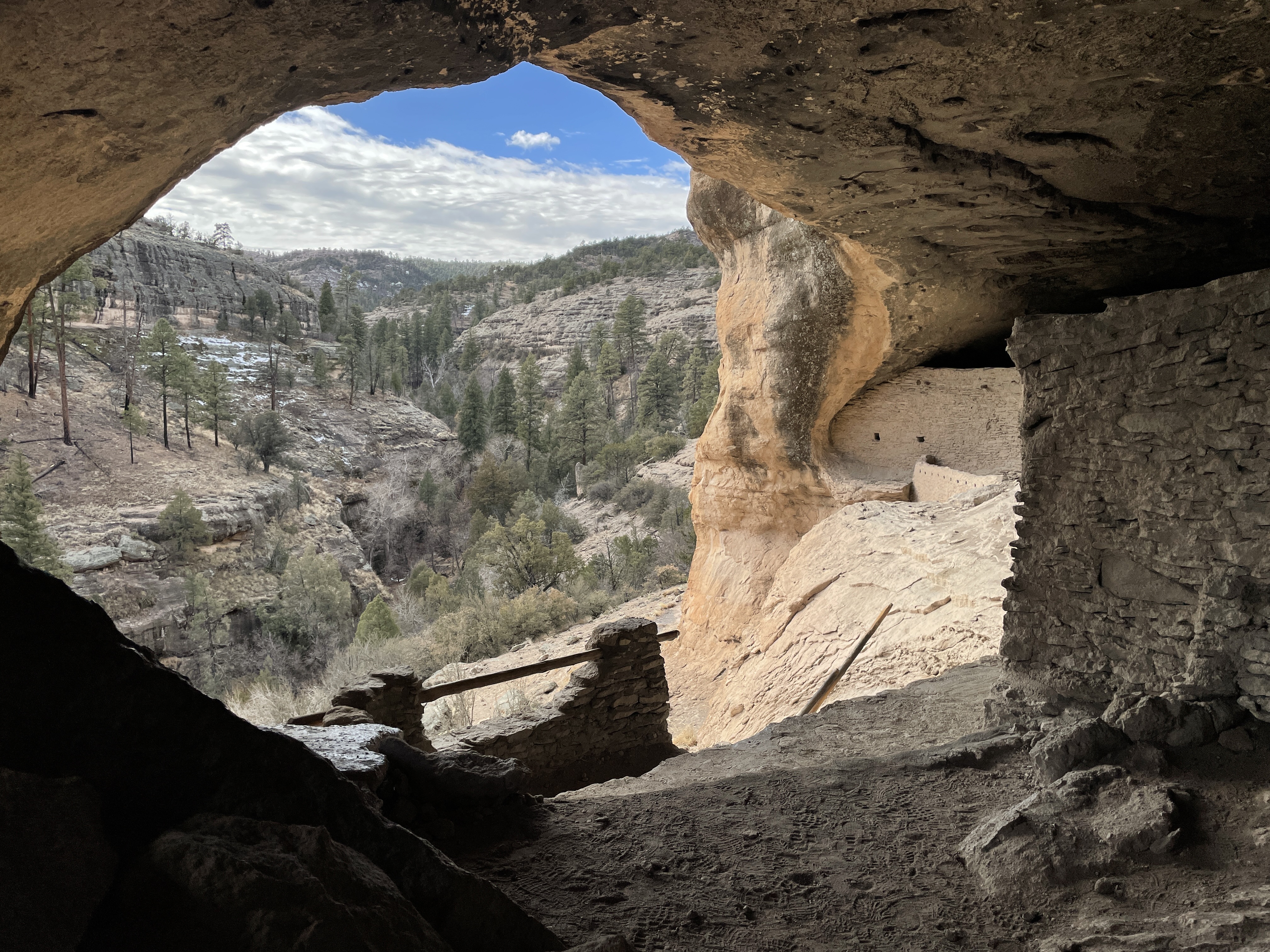
    The Cliff Dwellings Trail at Gila Cliff Dwellings National Monument may be short, but it is one of the most memorable walks in the National Park System. This easy-to-moderate loop trail is the only way to see the monument, leading visitors through a shaded canyon and into ancient cliff dwellings built more than 700 years ago.

    • Distance: ~1 mile
    • Elevation Gain: ~180 feet
    • Difficulty: Easy to Moderate (ladders required)
    • Trail Type: Loop
    • Typical Hiking Time: ~1 hour

    This trail is the only way to access the park. While there are steps and ladders to access the cliff dwellings, most people, including families, should be able to hike at least part of the trail.

    Reaching Gila Cliff Dwellings National Monument is part of the experience. From Silver City, a winding mountain road leads deep into the Gila Wilderness, the first designated wilderness area in the United States. By the time you arrive at the trailhead at the end of Cliff Dwellings Road, the landscape already feels remote and quiet.

    In the late 1200s, people of the Mogollon culture built these dwellings and lived here for one or two generations. They constructed rooms from stone and mortar, raised families, and relied on the natural shelter provided by the caves.

    A series of ladders allows visitors to climb into the dwellings themselves. Walking through these rooms is the highlight of the hike, offering views across the canyon and a powerful sense of connection to the people who once lived here.

    The Cliff Dwellings Trail is more than a short walk. It combines natural beauty, cultural history, and a strong sense of place, all within the setting of the Gila Wilderness. Though brief, the experience leaves a lasting impression.

    • Wear sturdy shoes with good traction.
    • Take your time exploring the dwellings.
    • Visit earlier in the day for cooler temperatures and fewer crowds.
    • Follow posted rules to help protect these fragile structures.

    This trail guide pairs with our Tuesdays on the Trail video episode, where we walk the Cliff Dwellings Trail and explore the dwellings themselves.

    The Cliff Dwellings Trail may only be about a mile long, but it delivers one of the most meaningful trail experiences in southwestern New Mexico. For visitors willing to make the drive, it offers a rare chance to walk through history in a quiet, beautiful setting.

  • The Long Road to Big Bend

    The Long Road to Big Bend

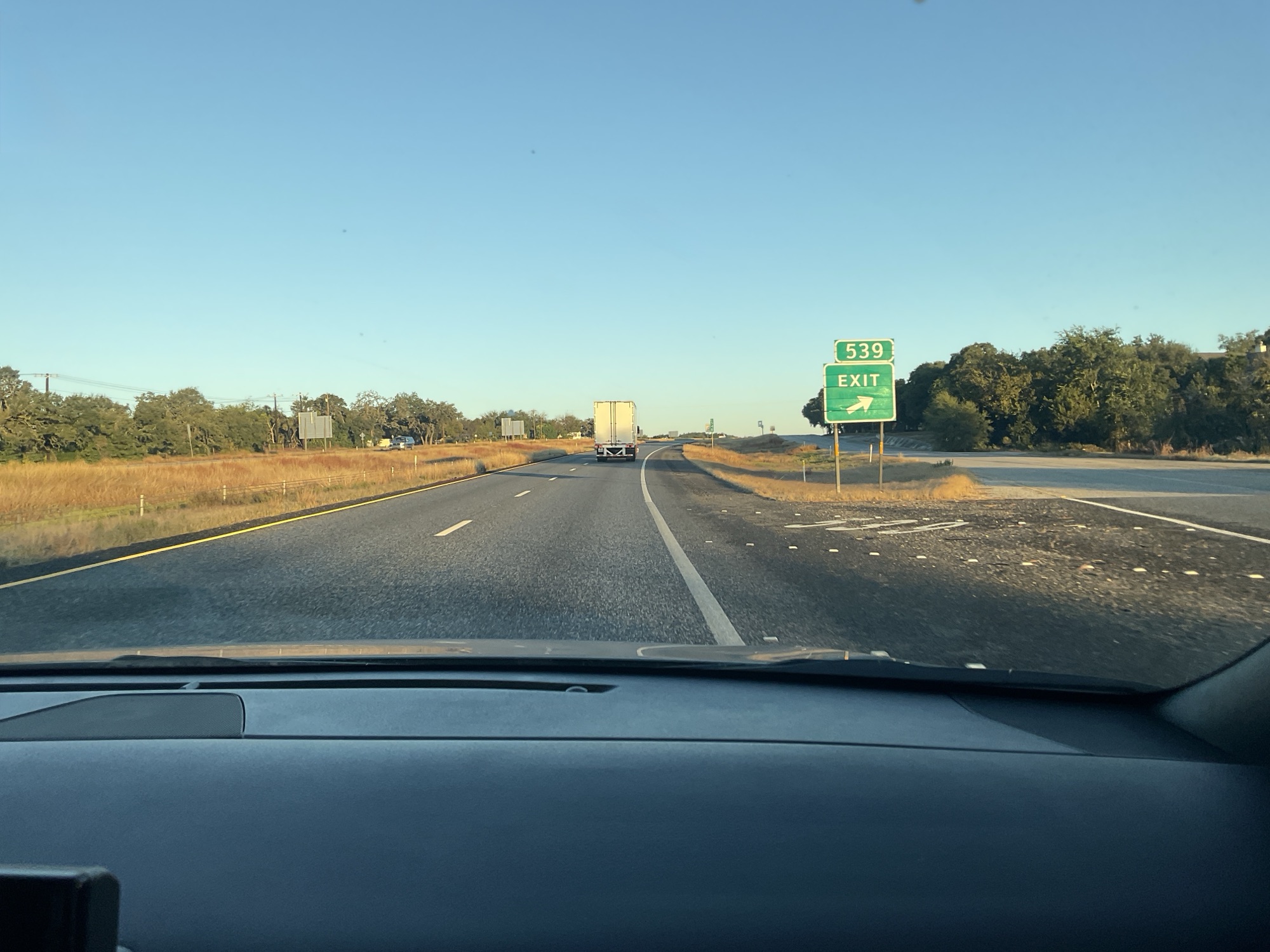
    West Texas stretches out in front of us, mile after mile of open road and widening sky. The drive has a rhythm now—long straightaways, the occasional small town, the sense that we’re leaving one world and easing into another. Cell service fades, radio stations come and go, and the landscape simplifies until it’s mostly earth, sky, and time.

    With every mile, Big Bend feels closer, even before we can see it. Mesquite and creosote line the highway, distant ridges ripple along the horizon, and the quiet grows more noticeable. This is the kind of drive that demands patience, but rewards it too. The remoteness is the point.

    Soon, the Chisos Mountains will rise ahead of us, and the road will begin to climb. By late afternoon, we expect to wind our way up into the Chisos Basin, just just in time to watch the sunset through the Window. After a full day on the road, the thought of pulling in, stepping out into cooler air, and finally being there is enough to keep us rolling.

    Big Bend is one of our favorite parks, and even before we arrive, it’s already doing what it does best—slowing us down and pulling us in.

    🎥 A look back at our very first Big Bend visit:

  • Day 4 Southern Caribbean Cruise: St. Thomas & St. John

    Day 4 Southern Caribbean Cruise: St. Thomas & St. John

    We woke up on Day 4 of our Southern Caribbean cruise to find St. Thomas, U.S. Virgin Islands waiting just outside our balcony. The Grand Princess was pulling into Charlotte Amalie Harbor, marking our first port of call of the voyage.


    Ferry to St. John and Virgin Islands National Park

    We took a short taxi ride to the marine terminal to catch the ferry to St. John and Virgin Islands National Park. We arrived early enough to enjoy a relaxing breakfast at the Petite Pump Room, located just above the ferry terminal. The omelet was excellent, and the sweeping views of the harbor were just as satisfying.

    Soon, it was time to board the ferry for the scenic 45-minute ride to St. John. The route skirts the southern shoreline of St. Thomas before turning northeast and crossing the narrow channel separating the two islands. Before long, we entered Cruz Bay, where we disembarked and began our exploration.


    Exploring Virgin Islands National Park

    A short walk from the ferry terminal brought us to the Cruz Bay Visitor Center for Virgin Islands National Park. This was our first visit to this national park, even though our time here would be relatively brief. The National Park Service manages nearly two-thirds of St. John, along with the adjacent Virgin Islands Coral Reefs National Monument, preserving both land and sea ecosystems.

    After checking in at the visitor center, we decided to hike the Lind Point Trail, heading toward Honeymoon Beach and Salmon Beach.


    Hiking the Lind Point Trail

    The Lind Point Trail conveniently splits into upper and lower paths, creating a pleasant loop hike. Along the way, we passed through one of the Caribbean’s most diverse dry tropical forests, where cactus and agave line the trail alongside tropical trees like gumbo limbo, known for its peeling red bark.

    The vegetation is dense in places, but every so often the trail opens up to reveal glimpses of the turquoise Caribbean waters below. Taking the upper trail, we soon reached Lind Point, where expansive views stretch across Cruz Bay to the south and the Caribbean Sea to the north.

    The trail continued along the ridge before beginning its descent—just over a mile from the trailhead—toward Honeymoon Beach.


    Honeymoon Beach and Salmon Beach

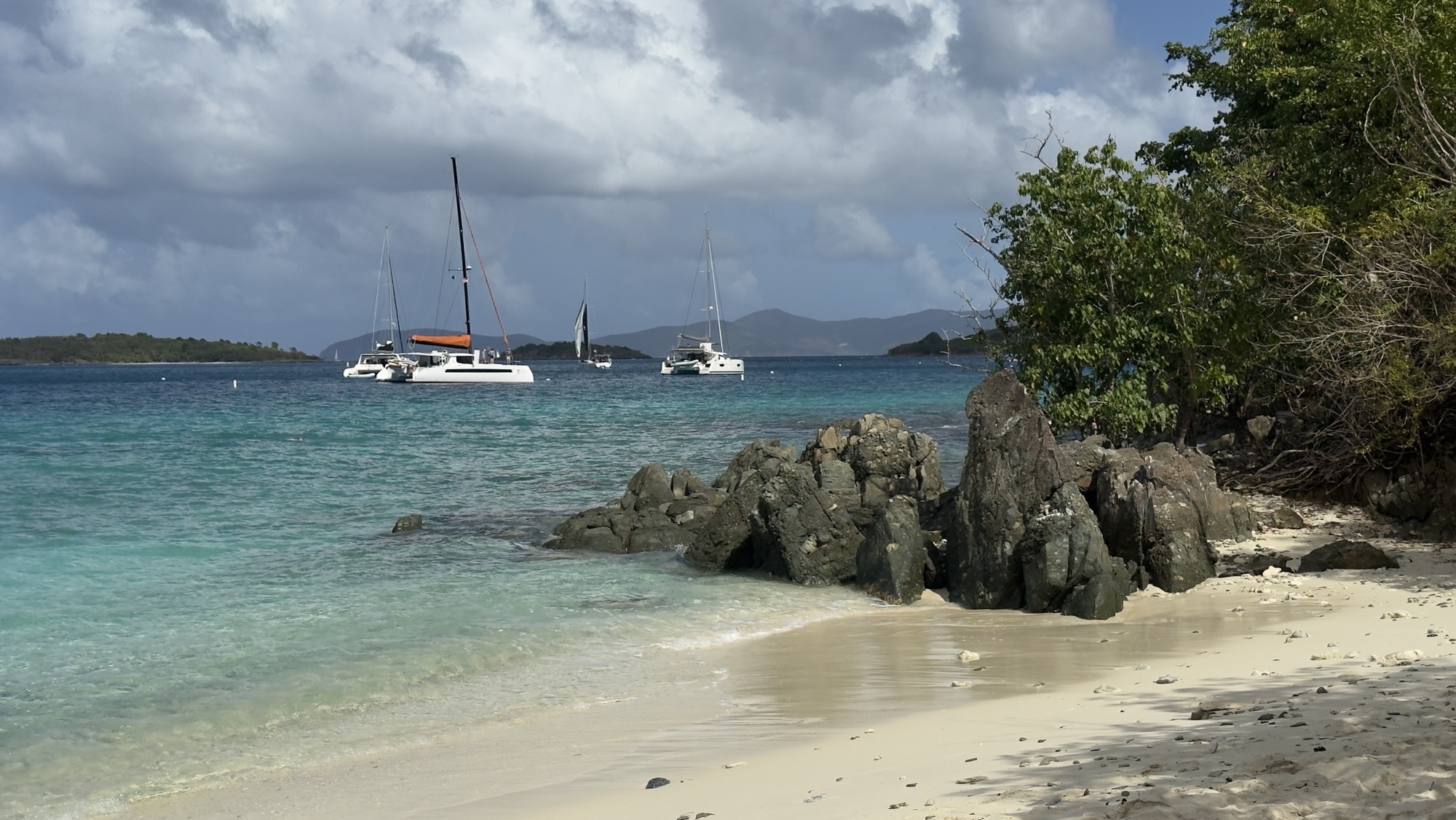
    The Virgin Islands are famous for their beaches, and Honeymoon Beach lives up to the reputation. Soft white sand meets crystal-clear blue water, making it an irresistible spot to linger. We hadn’t brought our swimsuits on this excursion—saving beach time for later in the cruise—but the water was incredibly inviting.

    On our return, we took the lower Lind Point Trail and soon came to the cutoff for Salmon Beach. Just as beautiful as Honeymoon Beach, Salmon Beach felt more secluded and noticeably less crowded, adding to its charm.


    Lunch with Unexpected Company

    Back at the Cruz Bay Visitor Center, we stopped for lunch. Our meal came with unexpected company—a hen and several chicks that appear to have claimed the visitor center as home. They seemed mildly offended that we didn’t share our lunch with them.


    Back to St. Thomas

    Before long, it was time to catch the ferry back to St. Thomas. Once there, we did a bit of shopping near the cruise pier before reboarding the Grand Princess. The rest of the afternoon was spent relaxing by the pool, enjoying a well-earned break after a full morning of exploring.

    As the sun set over St. Thomas, we sailed onward toward our next destination—St. Maarten—bringing a perfect close to an unforgettable day in the U.S. Virgin Islands.

  • Day 3: Canyon Vistas and a Moonlit Ascent

    Day 3: Canyon Vistas and a Moonlit Ascent

    Colorado Road Trip 2025

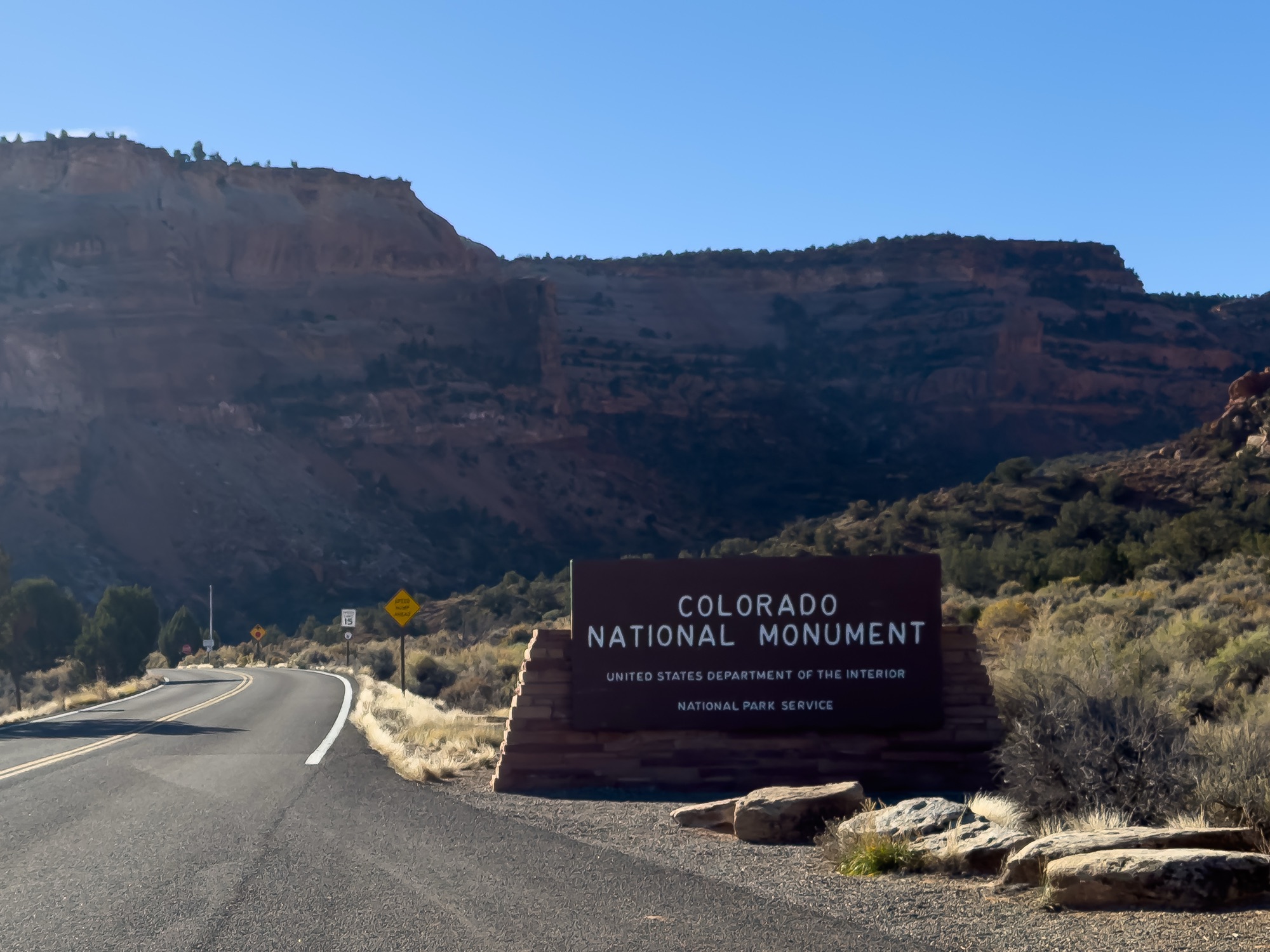
    Morning Hikes in Colorado National Monument

    We kicked off the day with a series of short hikes that showcased the monument’s breathtaking geology and expansive canyon views:

    Canyon Rim Trail – A perfect introduction to the park’s dramatic cliffs.

    Window Rock Trail – A short walk to a stunning natural window overlooking the canyon.

    Alcove Trail – A peaceful path with unique rock formations and quiet alcoves.

    Otto’s Trail – Named after John Otto, the monument’s founding advocate, this trail offers one of the best views of Independence Monument.

    Scenic Drive Along Rim Rock Drive

    After hiking, we took our time cruising along Rim Rock Drive, a 23-mile scenic route that winds through the heart of the monument. Every curve revealed new vistas—towering monoliths, deep canyons, and distant mesas.

    Towards the end of the drive, we were lucky enough to come upon a herd of grazing bighorn sheep, calmly navigating the rocky terrain just off the roadside. It was a quiet, majestic moment that reminded us of the wild beauty that thrives in these rugged landscapes.

    Eastbound on I-70: Beauty in Motion

    Leaving the monument, we headed east on Interstate 70, often called one of the most beautiful stretches of highway in America. The road climbs into the Rockies, passing through dramatic canyons, tunnels, and alpine forests.

    As we neared Dillon, the sky treated us to a spectacular show: a full moon rising over the Rocky Mountains, casting a silver glow on the peaks and following us all the way to Georgetown, where we’ll be staying for the next two nights.

  • Explore Our Alaska Cruise Highlights – 2025

    Explore Our Alaska Cruise Highlights – 2025

    Our journey through the breathtaking landscapes and historic towns of Alaska was nothing short of unforgettable. From misty fjords and glacier-carved valleys to charming coastal cities rich with gold rush history, every moment was a story worth capturing.

    We’ve curated a special photo collection featuring highlights from our Alaska 2025 Cruise—including stops in Juneau, Sitka, Skagway, and scenic views from aboard Anthem of the Seas. Whether you’re dreaming of your own Alaskan adventure or reliving memories of the Last Frontier, we invite you to explore the sights through our lens.

    📸 View the full collection here:

    👉 https://wirestock.io/collection/65032

    From historic parks and vibrant markets to glacier vistas and waterfront strolls, this gallery brings together the spirit of Alaska in every frame.

  • 🐊 A Quick Stop at Shark Valley: Everglades National Park

    While visiting family in Miami, we made a spontaneous stop at Shark Valley in Everglades National Park—and we’re so glad we did! Just west of the city, Shark Valley offers a unique window into one of the most fascinating ecosystems in the world.

    Since it was early May, the summer rains hadn’t arrived yet, and the Shark Valley Slough was mostly dry. But that didn’t mean it was quiet—far from it! Water still lingered in culverts and low spots, drawing in wildlife from all around.


    🚋 Exploring by Tram

    We hopped on the tram tour, which winds through 15 miles of sawgrass prairie, cypress domes, and hardwood hammocks. Along the way, we spotted:

    • A juvenile alligator sunning near the road

    • A Florida softshell turtle gliding through the water

    • A great blue heron wading in the shallows

    • And a mother alligator peeking out from a culvert!


    🏞️ Tower Views & Wildlife Moments

    The highlight of the tour was the observation tower, where we walked up the ramp and were rewarded with sweeping views of the Everglades stretching to the horizon. It was a peaceful, powerful reminder of the beauty and resilience of this landscape.


    📸 View the Full Gallery

    👉 Click here to view our collection of photos and videos from this

    👉 Click here to view our full photo and video collection


    Until the next adventure,

    —The Tezels

  • 🦣 A Mammoth-Sized Memory in Waco

    Exploring Prehistoric Texas with Our Granddaughter

    In early May, on our way to a convention in Dallas, we made a delightful stop at Waco Mammoth National Monument—and we’re so glad we did! This hidden gem in Central Texas offered a fascinating glimpse into the Ice Age, and sharing it with our granddaughter made the experience even more special.

    The highlight of our visit was the Dig Shelter, where we stood just feet away from the fossilized remains of Columbian mammoths, preserved exactly where they were discovered. The shelter is beautifully designed, allowing visitors to view the excavation site while learning about the mammoths’ story and the ongoing research.

    Our granddaughter was captivated by the size of the bones and the idea that these gentle giants once roamed the very ground we were standing on. The rangers were friendly and knowledgeable, and the shaded trails made for a peaceful walk through the surrounding woods.

    We captured a few moments on video, which you can watch below, and we’ve also shared a gallery of photos from our visit here:

    👉 View Our Waco Mammoth Photo Album

    If you’re ever passing through Waco, this site is well worth a stop—especially for families. It’s a perfect blend of science, history, and wonder.

    Until the next adventure,

    —The Tezels

    Watch our TikTok Post

    Bones of a camel embedded in the stone at the dig site.
Verified by MonsterInsights