Category: Travel Blog

Tezels on the Road is our family’s travel journal—capturing the adventures, mishaps, and magic of life on the move. From scenic drives and national parks to hidden gems and roadside surprises, we share stories, tips, and snapshots from the journey.

  • Big Bend Road Trip 2026: Scrambling Grapevine Hills and Soaking in Juniper Flats Views

    Big Bend Road Trip 2026: Scrambling Grapevine Hills and Soaking in Juniper Flats Views

    Day 3 – Grapevine Hills and Juniper Flats

    We eased into the day with a slow morning, lingering over coffee and soaking in the views of the Chisos Mountains right outside our window. Nature provided an unexpected show as clouds appeared to pour over the mountain rim and spill into the Basin below—a mesmerizing sight that reminded us why Big Bend National Park is so special.

    By late morning, we were ready to head out for our first hike: Grapevine Hills. Reaching the trailhead is an adventure of its own, with a gravel road that can be rough in spots but is well worth the effort.

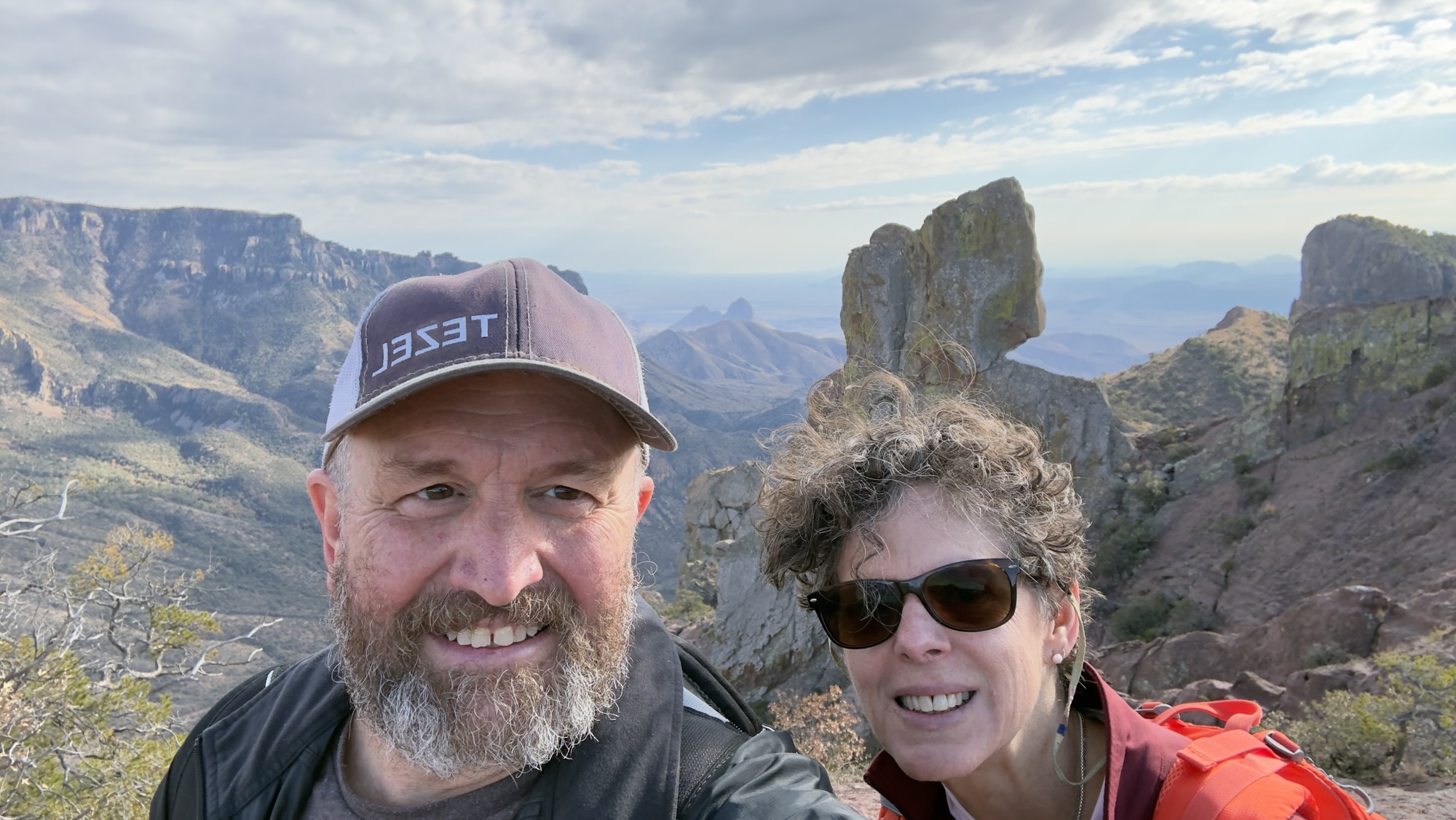
    The Grapevine Hills are a fascinating laccolith, formed when magma pushed upward beneath the surface and later erosion exposed the rock. Up close, the hills look like a chaotic jumble of massive boulders. The hike begins easily, following a dry wash through the center of the formation. That changes in the final quarter mile, where the trail climbs into the rocks and turns into a true scramble.

    We took our time navigating the boulders, carefully picking our way upward. While keeping our balance, we couldn’t help but think how much our grandkids would love this kind of hands-on adventure. The payoff comes at the end: a massive boulder perfectly balanced atop two others, framing a stunning view of the distant Chisos Mountains—one of Big Bend’s most iconic sights.

    After lunch back in the Basin, we set out for the final hike of this trip: the Pinnacles Trail to Juniper Flats. Like many Chisos trails, the views are rewarding all along the way, but the climb to Juniper Flats—about 240 feet above the Basin—opens up an especially impressive panorama. From this vantage point, we could take in Casa Grande to the east, Toll Mountain and Emory Peak to the south, the Window to the west, and the Basin spread out below us to the north.

    The Pinnacles Trail continues deeper into the high Chisos, eventually reaching Boot Canyon and the South Rim. That kind of strenuous trek wasn’t in the cards for this trip, but it definitely got us wondering whether it might be possible in the future—with a more dedicated training program. Big Bend has a way of inspiring new goals.

    We wrapped up our day with a short ranger-led walk near the Window View Trail, learning more about the park’s natural and human history. Just as we returned to our room, the Chisos Mountains ignited with deep reds and oranges as the sun set. It was the perfect ending to a memorable final evening in Big Bend National Park.

    See our Short from today’s adventures…

  • Day 2: Lost Mine Trail & Boquillas Canyon

    Day 2: Lost Mine Trail & Boquillas Canyon

    We woke to damp ground and low clouds drifting through the Chisos Basin, the result of light rain overnight. It wasn’t the most promising start for a hike on one of our favorite trails—Lost Mine—but in Big Bend, patience is often rewarded.

    The drive up to the trailhead at Panther Pass did little to boost our confidence. The sky stayed gray, and expectations were modest. Still, we found a parking spot—no small victory these days—and decided to take our chances. It turned out to be the right call.

    The Lost Mine Trail begins with a steady, moderate climb, and almost immediately delivers. The first three-quarters of a mile wind upward through welcome shade, offering expanding views into Green Gulch and the Basin Road climbing into the Chisos. The oak, juniper, and pine woodland here feels worlds away from the dry scrub of the Chihuahuan Desert below, a reminder of how dramatically Big Bend’s landscapes can shift with elevation.

    At the three-quarter-mile mark, the trail tops out on a ridge above Juniper Canyon, where the views begin to open and the work really starts. A seemingly endless series of switchbacks carries you higher, each turn revealing a little more of the park. At the top, the reward is one of the finest panoramas in Big Bend: Juniper and Pine Canyons and the southern Chisos to the south, the vast Chihuahuan Desert stretching east, Casa Grande rising to the west, and Lost Mine Peak to the north—its name tied to legends of Spanish prospectors searching for riches in these mountains.

    Just as we reached the summit, the clouds parted. The views were clear, dramatic, and fleeting. On the descent, the clouds rolled back in, and by the time we reached the parking lot, light rain had returned. Once again, our timing felt just about perfect.

    After lunch, we headed east toward Boquillas Canyon, one of the three major canyons carved by the Rio Grande. Rain followed us most of the way, falling harder as we drove, but as luck would have it, it stopped just as we arrived at the trailhead.

    The half-mile trail into the canyon is short and mostly easy, with a brief climb at the start. Inside the canyon, steep limestone walls close in, creating a quiet, intimate space that contrasts sharply with the openness of the desert. Twenty years ago, we brought two of our boys here, where they spent endless time climbing and sliding down a large sand hill. Today, that hill has been narrowed by a rockslide—time leaving its mark, as it always does.

    As we headed back toward the car, the rain returned, heavier this time. Fortunately, the trail is short, and we made it back without getting completely soaked.

    Back in the Chisos Basin, the day wound down quietly. Dinner on our balcony came with a front-row seat to sunset colors washing over Emory Peak, the clouds finally beginning to thin. But the day wasn’t quite finished.

    AThat evening, we drove down to Panther Junction for a ranger-led Star Talk. As an International Dark Sky Park, Big Bend delivers night skies that still feel overwhelming. Telescopes were set up, celestial objects came into focus, and stars filled every dark space above us.

    Tomorrow, we look forward to more hiking. If today was any indication, Big Bend still has plenty to offer.

    Watch our YouTube Short of the day:

  • Day 1 – Arriving in the Chisos Basin

    Day 1 – Arriving in the Chisos Basin

    Though long, the drive across West Texas is always worth it. Around 4:15 p.m., we turned onto the Basin Road and began our ascent into the Chisos Mountains. The higher we climbed, the desert shrubs gradually gave way to trees, transforming the landscape outside our windows.

    Soon, we were navigating the familiar switchbacks up to Panther Pass, cresting the divide and crossing into the Basin. This stretch is always memorable as the road descends into the high mountain valley, with the Window framed perfectly at the far end. No matter how many times we make this drive, it never fails to impress.

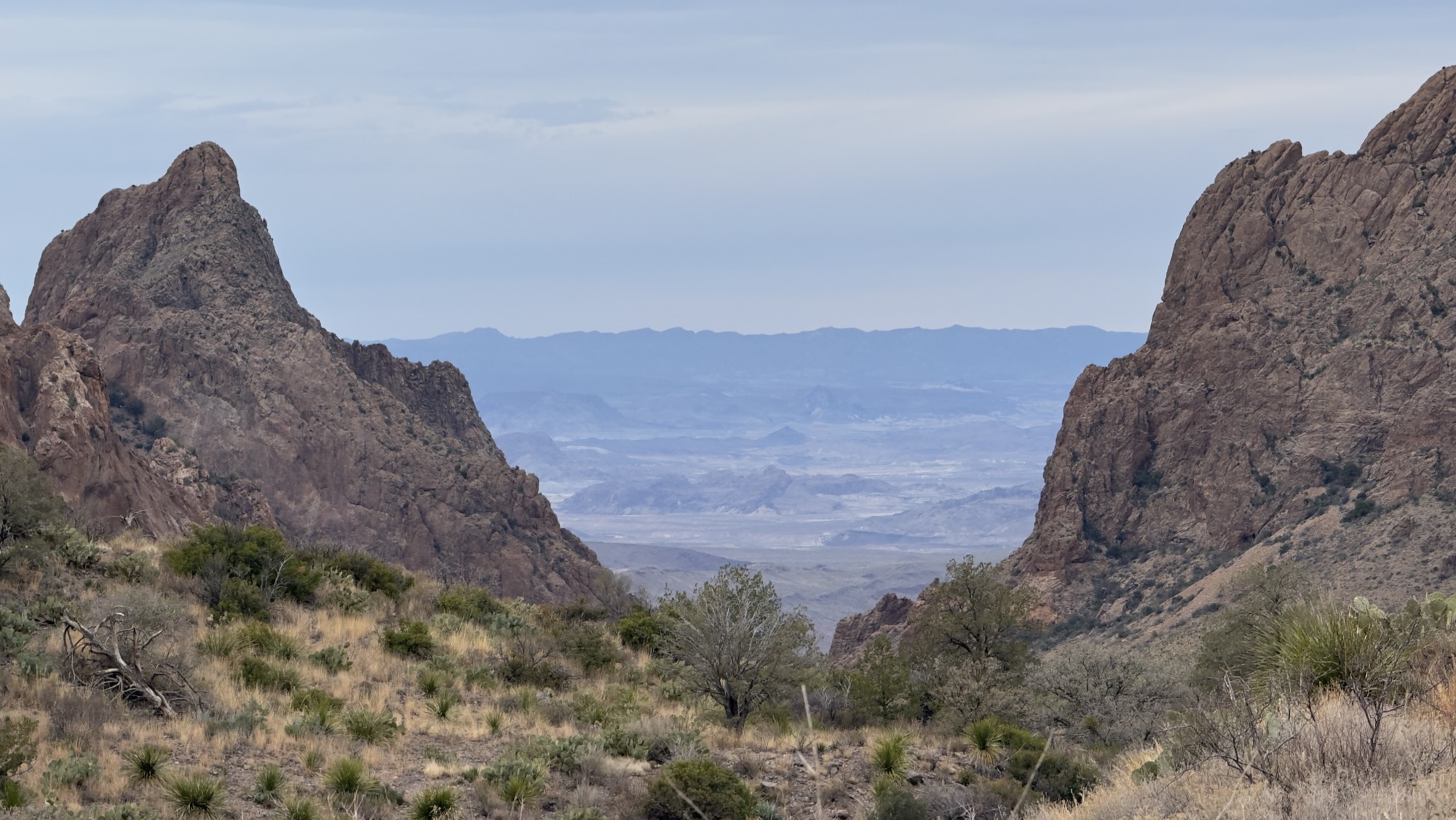
    After checking into our hotel room—home base for the next three nights—and unpacking, we set out for an easy walk on the Window View Trail. The flat, paved path offers little challenge, but the payoff is enormous. The views down through the Window and out across the desert below are simply breathtaking.

    We capped off the day with a simple dinner on our balcony, soaking in views of Emory Peak and the surrounding Chisos Mountains. Clouds obscured the sunset, but the wispy layers caught the fading light and created a quiet show of their own.

    It’s good to be back in Big Bend.

    Watch today’s YouTube Short…

  • The Long Road to Big Bend

    The Long Road to Big Bend

    West Texas stretches out in front of us, mile after mile of open road and widening sky. The drive has a rhythm now—long straightaways, the occasional small town, the sense that we’re leaving one world and easing into another. Cell service fades, radio stations come and go, and the landscape simplifies until it’s mostly earth, sky, and time.

    With every mile, Big Bend feels closer, even before we can see it. Mesquite and creosote line the highway, distant ridges ripple along the horizon, and the quiet grows more noticeable. This is the kind of drive that demands patience, but rewards it too. The remoteness is the point.

    Soon, the Chisos Mountains will rise ahead of us, and the road will begin to climb. By late afternoon, we expect to wind our way up into the Chisos Basin, just just in time to watch the sunset through the Window. After a full day on the road, the thought of pulling in, stepping out into cooler air, and finally being there is enough to keep us rolling.

    Big Bend is one of our favorite parks, and even before we arrive, it’s already doing what it does best—slowing us down and pulling us in.

    🎥 A look back at our very first Big Bend visit:

  • Southern Caribbean Cruise 2026 – Day 10

    Southern Caribbean Cruise 2026 – Day 10

    San Juan, Puerto Rico: History, Mofongo, and a Relaxed Farewell

    Our Southern Caribbean Cruise 2026 officially came to an end this morning as we woke up once again in San Juan, Puerto Rico. While the cruise itself was over, our Caribbean adventure wasn’t quite finished yet.

    After saying goodbye to the wonderful crew aboard the Grand Princess, we disembarked and headed to the airport to pick up a rental car. From there, we drove to the Courtyard by Marriott Isla Verde Beach Resort, where we dropped off our luggage and prepared to spend our final night in paradise.


    Exploring Old San Juan

    With the logistics out of the way, we made our way into Old San Juan, one of the most atmospheric and historic cities in the Caribbean. After parking, we spent the morning wandering the narrow, colorful streets of the old city, popping into shops and soaking in the sights and sounds of this vibrant port.

    Hunger eventually led us to Los Yeyo’s, a restaurant proudly known as “The House of Mofongo.” That alone made it an easy decision.

    We shared a crab mofongo along with a side of sweet plantains, and it did not disappoint. The mofongo arrived on a sizzling skillet, filling the air with an irresistible aroma. For those unfamiliar, mofongo is a traditional Puerto Rican dish made from fried plantains mashed with garlic and other ingredients. Los Yeyo’s crab mofongo was absolutely outstanding and easily one of our favorite meals of the trip.

    Castillo San Felipe del Morro (El Morro)

    After lunch, we continued exploring Old San Juan until we reached Castillo San Felipe del Morro, part of San Juan National Historic Site. Perched high on a promontory overlooking the entrance to San Juan Bay, El Morro is one of the most impressive fortifications in the Caribbean.

    Constructed over more than 250 years by Spanish engineers, El Morro reflects Spain’s determination to protect San Juan as a critical hub in the trans‑Atlantic trade routes. Walking along its massive walls and gazing out from its strategic vantage point, it’s easy to understand why such effort and resources were invested here. The fortress feels immense—an imposing, nearly impenetrable stronghold guarding the city.

    San Juan’s Defensive Network & Castillo San Cristóbal

    El Morro was only one element of San Juan’s elaborate defensive system. San Juan National Historic Site also preserves large sections of the original city walls, which completely encircled the city by 1783, as well as Fort San Juan de la Cruz (El Cañuelo) on the opposite side of the harbor.

    Our next stop was Castillo San Cristóbal, the largest fortification built by Spain in the New World. Unlike El Morro, San Cristóbal was designed primarily to defend the city from land-based attacks. Its sheer scale and layered defenses are just as impressive, showcasing remarkable military engineering and ingenuity.

    Together, these fortifications tell stories of ambition, empire, and conflict. For centuries, nations fought for control of this small but strategically vital island. Generations of soldiers lived and worked within these walls, and today visitors are inspired not only by the history, but also by the beauty and brilliance of this UNESCO World Heritage Site.

    A Relaxed Caribbean Evening

    After spending the afternoon immersed in over 500 years of history, we returned to the Courtyard by Marriott Isla Verde Beach Resort. Our room wasn’t quite ready, but that was hardly a problem. We found seats by the beach, ordered some sangria, and simply relaxed—reflecting on an unforgettable week in the Caribbean.

    Tomorrow brings a calm, easy morning before our late‑afternoon flight home to San Antonio. There’s no sign of winter weather here in San Juan, so we’re hoping that the weather on the mainland doesn’t affect our trip home.

  • Southern Caribbean Cruise 2026 – Day 9: A Perfect Sea Day on the Grand Princess

    Southern Caribbean Cruise 2026 – Day 9: A Perfect Sea Day on the Grand Princess

    Day 9 of our Southern Caribbean Cruise was our only full sea day, and we were more than ready for it. While we loved every port of call on this cruise, there’s something especially wonderful about a relaxed day at sea—no alarms, no shore excursions to rush to, and no embarkation or disembarkation schedules to manage.

    Sea days on Princess Cruises always seem to arrive at just the right moment, and this one was no exception.


    Culinary Demonstration: A Princess Cruises Favorite

    As is tradition on the last sea day of a Princess cruise, we attended one of our favorite onboard events: the Culinary Demonstration in the Princess Theater.

    The ship’s Executive Chef Arturo and Director of Restaurant Operations, Erdal, gave us a fascinating behind‑the‑scenes look at what it takes to feed nearly 2,700 passengers every day. Chef Arturo then took center stage, preparing a beautiful Pasta al Pesto and spicy Diablo Shrimp, with Erdal assisting. As always, the aromas alone were worth the visit, filling the entire theater.


    Black Forest Cake (and a Little Friendly Competition)

    After the savory dishes were complete, the attention turned to dessert. The head pastry chef created an absolutely stunning Black Forest Cake, showcasing the high level of skill found in Princess Cruises’ pastry kitchens.

    As usual, Erdal joined in with his own version of the cake. While perhaps not as visually refined as the pastry chef’s creation, it added a dose of humor to the demonstration—a reminder that these events are as entertaining as they are informative.


    A Behind‑the‑Scenes Galley Tour

    Following the demonstration, we were treated to a guided tour of one of the two main galleys aboard the Grand Princess. Walking through the kitchen really drives home the scale of the operation and the level of organization required to keep thousands of passengers happily fed.

    Seeing where all that food is prepared made lunch later at the Horizon Court even more enjoyable—especially knowing we were tasting some of the very dishes we had just watched being prepared.


    Our Final Evening at Sea

    A lazy afternoon onboard led us into our final evening at sea. We enjoyed one last dinner in the elegant Michelangelo Dining Room, followed by the Farewell Variety Show in the Princess Theater.

    Entertainers Ashley Rose Smith and Radio Recall, who had performed earlier in the cruise, returned for one final performance. The show concluded with a moving moment as crew representatives filled the stage, giving passengers the chance to thank the entire crew with a heartfelt standing ovation.


    Looking Ahead to San Juan

    Tomorrow morning, we arrive back in San Juan, Puerto Rico. While it will be time to disembark the Grand Princess, our journey isn’t quite over yet—we’ll still have a full day in Puerto Rico before flying home Monday evening.

    Sea days like this one are the perfect way to reflect, relax, and savor the final moments of an unforgettable Southern Caribbean cruise.

  • 🛳️ Southern Caribbean Cruise 2026 – Day 8: Barbados’ Wild Atlantic Coast

    🛳️ Southern Caribbean Cruise 2026 – Day 8: Barbados’ Wild Atlantic Coast

    Our final port of call on our Southern Caribbean Cruise was Bridgetown, Barbados. While Barbados is often grouped with the Caribbean, the island actually sits outside the Caribbean Sea, fully exposed to the Atlantic Ocean. Overnight, we crossed the invisible line separating the Caribbean Sea from the Atlantic, arriving at an island that feels distinctly different from the others we visited on this cruise.

    Locals still refer to the Caribbean side of Barbados versus the Atlantic side, and the contrast is striking. The Caribbean-facing coast features calm waters and sandy beaches, while the Atlantic side is rugged and dramatic, with rocky shorelines and powerful surf. Very few boats operate along the Atlantic coast due to the treacherous tides and unforgiving shoreline.


    A Coral Island, Not a Volcanic One

    Unlike many of its Caribbean neighbors, Barbados is not volcanic. Instead, the island is an ancient coral reef that was uplifted from the ocean floor over time. Evidence of this coral origin is everywhere, especially in the limestone that makes up much of the island.

    Barbados is also not mountainous, but rather defined by gentle, rolling hills. These conditions created fertile soil, perfect for agriculture—and like much of the Caribbean, sugar cane once dominated the economy.


    4×4 Scenic Drive with Island Safari Barbados

    Today’s adventure was the 4×4 Scenic Panoramic Drive & Bathsheba Beach tour with Island Safari Barbados. Our guide, Andre, was equal parts informative and entertaining. While we were warned about plenty of bouncing during the off-road portions, the vehicle was comfortable, and the open sides provided fantastic views of the countryside.

    Climbing out of Bridgetown (before the 4×4 portion began), we passed through farmland growing sweet potatoes, cassava, and sugar cane. Along the way, we saw remnants of Barbados’ sugar plantation era—boiling houses, plantation homes, and even a 300-year-old stone bridge spanning a gully. Built by enslaved workers, the bridge stands as a sobering monument to the labor that sustained the sugar industry.


    Limestone Roads and Fossilized Coral

    The legacy of sugar cane also shaped Barbados’ road system. Cart paths were cut directly into the limestone to transport goods from inland plantations down to coastal ports. In many places, you can clearly see fossilized coral embedded in the stone, a reminder of the island’s ancient reef origins.

    One of the true off-road highlights was driving into a gully, formed when limestone caves collapse. Barbados is riddled with caves and gullies, and these areas provide some of the best up-close views of coral fossils.


    Hackleton’s Cliff: A View from 1,000 Feet

    About an hour into the tour, we made our first stop at Hackleton’s Cliff, located between the rural parishes of St. Joseph and St. John. Rising nearly perpendicular from the surrounding land, the cliff reaches 1,000 feet above sea level and offers sweeping views of Barbados’ Atlantic coastline.

    The cliff is named for Thomas Hackleton, a plantation owner who, according to local lore, died by riding his horse off the cliff after becoming entangled in a scandal. Hackleton and several others are buried here, adding a layer of haunting history to the already dramatic setting.


    Bathsheba Beach and the Atlantic Coast

    From Hackleton’s Cliff, we descended toward the coast, spotting Barbados Blackbelly sheep grazing in open fields and catching brief glimpses of the island’s famous green monkeys. Unfortunately, the monkeys were extremely camera-shy, denying us that elusive photo.

    Our second major stop was Bathsheba Beach, located on Barbados’ wild Atlantic shore. The name “Bathsheba” comes with its own legend—some say the mineral-rich waters resemble the biblical Bathsheba’s milk baths, believed to preserve beauty. Myth or not, the beach’s natural beauty is undeniable.

    We walked along the rocky shoreline, watching waves crash against dramatic rock formations while a few surfers took full advantage of the powerful Atlantic swells.


    A Nautical Farewell to Barbados

    As we sailed away from Barbados, we were treated to a fascinating maritime moment: the harbor pilot disembarking the Grand Princess. The ship doesn’t slow down as a small pilot boat pulls alongside and the pilot descends a rope ladder—a carefully choreographed nautical “dance” that’s always a thrill to watch.


    Evening Entertainment at Sea

    The evening brought excellent entertainment, starting with “Born to Dance” in the Princess Theater. Later, musicians from around the ship gathered in the Piazza to perform hits from around the world, creating a lively and celebratory atmosphere.

    Tomorrow brings a sea day as we head back toward San Juan. Our cruise may be nearing its end, but the memories—especially of Barbados’ wild Atlantic coast—will last long after we’re home.

  • Southern Caribbean Cruise 2026 – Day 7: Waterfalls, Volcanoes, and Champagne Reef in Dominica

    Southern Caribbean Cruise 2026 – Day 7: Waterfalls, Volcanoes, and Champagne Reef in Dominica

    Port of Call: Roseau, Dominica

    Today we arrived in Roseau, Dominica, an island that is dramatically mountainous, incredibly green, and very wet. Dominica is the youngest island in the Lesser Antilles, still actively shaped by geothermal and volcanic activity—something we experienced firsthand.

    Heavy rain greeted us upon arrival, introducing us immediately to just how damp this island can be. Even the “dry” coastal areas receive about 75 inches of rain annually, while parts of the mountainous interior can see as much as 390 inches per year.


    🚐 Into the Mountains of the “Nature Island”

    We joined the Trafalgar Falls & Champagne Reef Snorkel Tour with Venture Ashore. Leaving the pier—where Grand Princess was docked—we drove through the relatively “flat” (a very relative term here) capital city of Roseau, before heading up into the mountains toward Morne Trois Pitons National Park.

    Dominicans take great pride in protecting their natural surroundings and proudly refer to their home as the “Nature Island of the Caribbean.” This UNESCO World Heritage Site makes it easy to understand why. Deep canyons slice through rugged volcanic mountains as the road winds through dense tropical rainforest, offering views of the geological forces that continue to shape the island.

    We were especially thankful for our skilled driver, who navigated the steep, narrow, and winding mountain roads with ease.


    🌊 Trafalgar Falls: Papa and Mama

    Our first stop was the iconic Trafalgar Falls. A short—but always wet—10‑minute walk through the forest led us to a viewing platform overlooking the twin waterfalls: the taller “Papa” Falls and its shorter companion, “Mama” Falls.

    Papa Falls originates from a mountain lake high above

    Mama Falls flows from the “Breakfast River”

    Just below the falls, the two tributaries merge and continue on through Ti‑Tou Gorge as the Roseau River.

    Prior to a landslide in 1995, hot springs and pools existed at the base of Papa Falls. Geothermal activity still warms the water here, making it noticeably cooler at Papa Falls compared to Mama Falls—a fascinating reminder of Dominica’s volcanic core.

    Locals refer to the trail as a “stroll,” though that may be a bit misleading. While not overly difficult, the path is rocky, steep in places, and perpetually wet, so sturdy footwear is highly recommended.


    🌋 Sulphur Springs and Volcanic Features

    Back aboard the bus, we continued deeper into Morne Trois Pitons National Park, stopping briefly at a fumarole (sulphur spring) just off the roadside.

    Here, sulphur gas bubbles up through pools of water and mud, releasing the unmistakable scent of volcanic activity. Locals claim the mineral‑rich mud and water have healing properties—but that remains happily unverified science.


    🤿 Snorkeling Champagne Reef

    Our final stop was Champagne Reef, where we geared up for a unique snorkeling experience. The reef gets its name from volcanic gases that escape through the seafloor, creating streams of bubbles that rise through the water like champagne.

    From the rocky shore, our snorkel guide led us along the coast, where we spotted coral formations and tropical fish below. Soon we reached the bubbling vents, swimming among warm currents of escaping gas.

    At one point, our guide captured some of the bubbling water in his hands and brought it to the surface so we could feel just how much warmer it was. According to local legend, simply running your hands through the water can shave ten years off your age—we’ll report back on that claim.


    🌙 Evening Aboard Grand Princess

    That evening, Grand Princess sailed away from Dominica. After dinner, we attended the Captain’s Circle Reception, where we learned that Captain John Foster, spending his final night aboard for this contract, is not only an experienced ship’s captain but also quite the comedian.

    We caught part of the production show in the Princess Theater before retiring to our cabin, watching the lights of Martinique glow in the distance.


    🌴 Up Next: Our Final Port – Barbados

    Tomorrow marks our last port of call as we arrive in Bridgetown, Barbados, wrapping up our Southern Caribbean port visits.

  • Southern Caribbean Cruise 2026 – Day 6: History, Forts, and Beaches in Antigua

    Southern Caribbean Cruise 2026 – Day 6: History, Forts, and Beaches in Antigua

    ⚓ Port of Call: St. John’s, Antigua and Barbuda

    This morning, Grand Princess sailed into St. John’s, Antigua and Barbuda, a former British colony rich with Caribbean history. We spent the day on a Half Day Historical Tour with Voyages Antigua, which turned out to be an excellent and well‑paced introduction to the island.

    🚐 Exploring Antigua by Mini‑Bus

    We boarded a comfortable mini‑bus with our driver, Dr. Drew, and our incredibly knowledgeable guide, Carl. Heading south out of St. John’s, we traveled through the mostly flat northern portion of Antigua.

    Carl explained that this flat terrain—combined with volcanic ash deposits—created some of the most fertile farmland in the Caribbean. This made Antigua particularly well‑suited for sugar cane cultivation, which shaped the island’s economy for centuries.

    🌾 Sugar Cane, Rum, and a Complicated Past

    The British highly valued Antigua’s sugar cane fields and invested heavily in protecting them. Unlike many Caribbean islands, Antigua did not frequently change hands between European powers.

    Sugar cane had many uses, but none more profitable than its role in producing rum. Cane was processed into molasses, which was shipped to Britain where rum was distilled.

    This economic success came with devastating moral consequences. The ships that transported molasses to the British Isles were part of the infamous triangular trade, delivering enslaved Africans to Antigua to work the plantations before returning to England loaded with molasses. It is difficult to comprehend that systems of forced labor persisted in Antigua into the 1960s.

    Today, Antigua proudly stands as an independent nation, having gained independence from Britain in 1981, while remaining a member of the Commonwealth of Nations.

    🏰 Antigua’s Historic Fortifications

    The Blockhouse

    Our first historic stop was The Blockhouse, one of approximately forty forts built by the British to defend Antigua. Sitting high above the Caribbean Sea on the island’s more rugged southern end, the Blockhouse offers sweeping 180‑degree views, ideal for spotting approaching ships.

    Shirley Heights

    Just a short drive away, we arrived at Shirley Heights, overlooking English Harbour and Falmouth Harbour. The panoramic views here are nothing short of breathtaking, and the strategic importance of this location becomes immediately clear.

    ⚓ Nelson’s Dockyard National Park (UNESCO World Heritage Site)

    Our final historical stop was Nelson’s Dockyard, a UNESCO World Heritage Site and one of the highlights of the day.

    Developed by the British Royal Navy, the sheltered harbor is surrounded by high cliffs that protected ships from hurricanes while providing an ideal place for repairs and resupply. The beautifully preserved Georgian‑style buildings are still in use today, making Nelson’s Dockyard both a working harbor and a living museum.

    🏖️ Beach Time at Pigeon Point

    After exploring Antigua’s past, we shifted into relaxation mode at Pigeon Point Beach. Antiguans are very proud of their beaches and boast that they have 365, one for each day of the year. This idyllic spot offered calm waters and postcard‑perfect views.

    The water was a little chilly at first, but we quickly acclimated—and the refreshing swim, combined with the scenery, made this a perfect way to end the day ashore.

    🌙 Evening Aboard Grand Princess

    Back on board, we enjoyed another excellent dinner in the Michelangelo Dining Room. Before the evening show, we caught an entertaining dance performance in the promenade.

    We wrapped up the night in the Princess Theater with the production show “Sweet Soul Music,” a lively and well‑produced performance.

    As Grand Princess sailed onward, we turned in with anticipation for the next port.

    🌴 Up Next: Day 7 in Dominica

    Tomorrow morning, we arrive in Roseau, Dominica, for Day 7 of our Southern Caribbean adventure.

Verified by MonsterInsights