Tag: Southern Arizona Road Trip 2021

  • Coronado National Memorial

    Perched on the US–Mexico border in the rugged Huachuca Mountains of southern Arizona, Coronado National Memorial commemorates one of history’s most audacious journeys — the 1540–1542 expedition of Francisco Vásquez de Coronado in search of the legendary Seven Cities of Gold. This companion guide to our First Encounters episode offers practical context, history, and planning information to help you prepare for your own first visit.

    Quick Facts

    • Location: Hereford, Arizona — south of Sierra Vista, near the Mexico border
    • Established: 1952
    • Commemorates: The Coronado Expedition of 1540–1542, the first organized European exploration of the American Southwest
    • Setting: Southeast flank of the Huachuca Mountains, bordered by Coronado National Forest
    • Entrance Fee: None
    • Hours: Open daily, dawn to dusk; Visitor Center open 8:00 AM – 4:00 PM (closed Thanksgiving and Christmas)
    • Address: 4101 E. Montezuma Canyon Road, Hereford, AZ 85615

    Why Coronado National Memorial Matters

    In 1540, Francisco Vásquez de Coronado led one of the most ambitious overland expeditions in history — 339 European soldiers and more than a thousand Aztec allies crossing arid deserts and rugged mountains in search of mythical cities of gold. They found something far more complex: a living world of Indigenous nations, dramatic landscapes, and cultural traditions that would be forever changed by the encounter.

    Coronado National Memorial marks the approximate spot where that expedition crossed into what is now Arizona, entering through the San Pedro River valley near Montezuma Pass. The site honors not just the expedition itself, but the centuries of cultural collision, exchange, and influence that followed — a story that still resonates in the Southwest today. It also stands as a gesture of goodwill between the United States and Mexico, recognizing the shared history that binds both nations.

    The Coronado Expedition

    Born in Salamanca, Spain in 1510, Francisco Vásquez de Coronado arrived in Mexico in 1535 and was appointed governor of Nueva Galicia. Fueled by reports from a priest named Fray Marcos de Niza — who claimed to have seen glittering cities to the north — Coronado was chosen to lead an expedition northward in search of the Seven Cities of Cíbola.

    On July 7, 1540, the expedition reached the first of these supposed golden cities — and found instead a rocky Zuni pueblo called Hawikuh. No gold. No jewels. What followed was a two-year journey through the Southwest and Great Plains, reaching as far as present-day Kansas, driven by one rumor of riches after another. Though Coronado returned to Mexico in failure, his expedition opened the door to Spanish colonization of the Southwest and set in motion centuries of cultural transformation for the Indigenous peoples of the region.

    Visiting the Memorial

    The entrance road climbs gradually into oak woodland before reaching the visitor center, which offers exhibits on Coronado’s expedition, the region’s ecology, and the area’s pre-contact history. Nine archaeological sites associated with the Cochise Culture — spanning from roughly 9000 B.C. to 2100 B.C. — surround the memorial.

    From the visitor center, the road continues up Montezuma Canyon — paved for the first five miles, then becoming a narrow, unpaved road with tight switchbacks — climbing to Montezuma Pass at 6,575 feet. Vehicles longer than 24 feet are not permitted on this upper road. The views from the pass sweep across the San Pedro River Valley and San Rafael Valley, with distant mountains visible deep into Mexico.

    Trails

    The memorial offers eight miles of trails through grasslands, oak forests, and mountain terrain:

    • Coronado Cave Trail: 0.75 miles from the visitor center (1.5 miles round trip) to a 600-foot-long limestone cavern. A free permit is required from the visitor center. Bring two flashlights per person, sturdy shoes, and water. Allow about two hours for the round trip and cave visit.
    • Coronado Peak Trail: A short, steep climb from Montezuma Pass to the summit at 6,864 feet, offering 360-degree panoramic views — including into Mexico. Part of the Arizona National Scenic Trail.
    • Joe’s Canyon Trail: A 6.2-mile trail descending 1,350 feet from Montezuma Pass through grassland and oak woodland back to the visitor center. Best done one-way with a car shuttle.
    • Yaqui Ridge Trail: Just over one mile, descending 500 feet to the international boundary marker at the US–Mexico border — also the southern terminus of the 800-mile Arizona Trail.

    A Birder’s Paradise

    Southeast Arizona is one of the top birding destinations in North America, and Coronado National Memorial sits at the convergence of four major ecosystems — the Rocky Mountains, Sierra Madre Mountains, Sonoran Desert, and Chihuahuan Desert. This remarkable overlap creates extraordinary habitat diversity. Visitors regularly spot roadrunners, Gambel’s quail, Mexican jays, peregrine falcons, hummingbirds, and vermilion flycatchers. The park provides a downloadable bird checklist on its website.

    Know Before You Go

    • No food, water, or Wi-Fi is available within the park — bring everything you need
    • The upper road to Montezuma Pass is unpaved, narrow, and not suitable for vehicles over 24 feet
    • The memorial borders Mexico — be aware of your surroundings, as the area sees smuggling and border crossing activity
    • Elevation at Montezuma Pass is 6,575 feet — altitude effects are common; stay hydrated
    • Afternoon thunderstorms are common during summer monsoon season (July–September)
    • Firearms must be securely stored; hunting and wood gathering are not permitted
    • A free cave permit is required before hiking to Coronado Cave — pick it up at the visitor center

    The Arizona Trail Connection

    Coronado National Memorial holds a unique distinction: it is the southern terminus of the Arizona National Scenic Trail, a continuous 800-mile route stretching from the US–Mexico border all the way to the Utah state line. Standing at the Yaqui Ridge trailhead, you’re at the very beginning — or very end — of one of America’s great long-distance trails.

    Visitor Center & Nearby Amenities

    The visitor center offers exhibits, a picnic area, and staff who can answer questions and issue cave permits. There are no restaurants or lodging within the park. Sierra Vista, about 20 miles north, is the closest city with a full range of dining, lodging, and services — including EV charging stations. The nearby San Pedro Riparian National Conservation Area and Kartchner Caverns State Park make excellent additions to a longer visit.

    Further Exploration

    First Encounters Video

  • Trail Guide – Overlook Ridge Trail

    Overlook Ridge Trail

    Fort Bowie National Historic Site • Arizona

    The Overlook Ridge Trail is the return option that changes how you understand Fort Bowie. Instead of retracing your steps, this route climbs above the fort and rewards you with sweeping views across Apache Pass—showing why this location mattered, and how carefully it was chosen.

    It’s a more exposed and more strenuous way back to the trailhead, but the perspective it provides is hard to match.

    Trail Overview

    • Trail Name: Overlook Ridge Trail
    • Park / Site: Fort Bowie National Historic Site
    • Location: Ridge above the fort ruins; reconnects with the main route to the trailhead.
    • Distance: Third-party estimates commonly place this segment around ~1.2–1.3 miles (varies by mapping source)
    • Difficulty: More strenuous than the main route (steeper, more exposed)
    • Best Use: As a return route to form a loop with the Fort Bowie Access Trail

    Where the Overlook Ridge Trail Fits

    Most visitors reach Fort Bowie by hiking the main access route through Apache Pass. From the fort area, the Overlook Ridge Trail provides an alternate return that climbs above the site and reconnects with the main trail closer to the trailhead.

    Hiking the Ridge

    The climb is where you feel the difference: the route is steeper and more exposed, and the ridge puts you out in the open where sun and wind are part of the experience. In return, you gain the big-picture view—looking down on the fort and across the surrounding landscape.

    Highlights Along the Way

    • High-angle views looking down on the fort ruins.
    • Wide views across Apache Pass and surrounding mountain ranges.
    • A stronger sense of why this site was strategically located.

    What Makes This Trail Special

    The Overlook Ridge Trail is about perspective. The main route brings you into the story through artifacts and landscape; the ridge brings you above the story and shows you the geography that shaped it. Together, the two trails make a loop that feels complete. [1](https://www.mypacer.com/routes/oi4b6v/overlook-ridge-trail-hiking-bowie-arizona)

    Tips for Visiting

    Watch the Trail on Tuesdays on the Trail

    We used the Overlook Ridge Trail as our return route from Fort Bowie, highlighting the views and the context it adds to the hike.

    Helpful Links & Resources

    Explore More with Tezels on the Road

    Find more trail guides, videos, and travel stories from our journeys through national parks and public lands.

  • Trail Guide – Fort Bowie Access Trail

    Fort Bowie Access Trail

    Fort Bowie National Historic Site • Arizona

    The Fort Bowie Access Trail is one of those hikes where the walk is inseparable from the place you’re visiting. Fort Bowie is a hike-in historic site reached on foot through Apache Pass, and that approach puts the story in the landscape long before you reach the fort ruins.

    Along the way, you pass layers of history—including the ruins of the Butterfield Overland Mail stage station and a small cemetery—before arriving at the broad hillside of fort foundations and interpretive areas.

    Trail Overview

    • Trail Name: Fort Bowie Access Trail
    • Park / Site: Fort Bowie National Historic Site
    • Location: Near Bowie, Arizona (Apache Pass)
    • Distance: ~1.5 miles one way to the fort / visitor center (about ~3 miles round trip)
    • Difficulty: Easy to Moderate (sun exposure; uneven footing in places)
    • Trail Type: Out & back (or combine with Overlook Ridge for a loop option)
    • Typical Hiking Time: ~2–3 hours round trip plus time exploring the ruins

    Getting to the Trailhead

    Getting to the Fort Bowie trailhead is part of the experience. From the highway, you follow an unpaved road through Apache Pass to the parking area. From there, Fort Bowie is reached on foot.

    Tip: Cell service can be limited in remote areas. Download maps ahead of time, start earlier in the day, and carry water—especially in warmer months.

    Hiking the Trail

    The walk in is about a mile and a half one way, and it does something few park sites do: it slows you down and places the story in the landscape before you ever reach the ruins.

    Along the trail, you pass the remains of the Butterfield Overland Mail stage station—an important stop along a transcontinental route—and then the post cemetery, a quiet reminder of the human cost of life and conflict in this place.

    Fort Bowie was established to protect Apache Pass and Apache Spring, a reliable water source that made this area strategically important. The fort and surrounding landscape became central to the conflict between the U.S. Army and the Chiricahua Apache during the Apache Wars.

    Highlights Along the Way

    • Apache Pass landscapes and big-sky desert views.
    • Butterfield stage station ruins (wide views and close detail)
    • Post cemetery and interpretive waysides
    • Fort foundations spread across a broad hillside

    History & Context

    Fort Bowie preserves the story of a landscape shaped by travel, water, and conflict. Today, the National Park Service describes the fort and visitor center as accessed by a three-mile scenic loop hike through the historic ground of Apache Pass.

    What Makes This Trail Special

    The Access Trail makes Fort Bowie feel earned. The approach builds context—stage route ruins, cemetery, water source, and landscape—so when you finally stand among the foundations, the place makes sense in a deeper way.

    Tips for Visiting

    • Water & sun: carry water and sun protection—shade can be limited.
    • Footing: expect uneven sections and desert wash crossings.
    • Time: allow extra time for waysides, ruins, and the visitor center area.

    Watch the Trail on Tuesdays on the Trail

    This trail guide pairs with our Tuesdays on the Trail episode on Fort Bowie—walking the route through Apache Pass and exploring the ruins.

    Helpful Links & Resources

    Explore More with Tezels on the Road

    Find more trail guides, videos, and travel stories from our journeys through national parks and public lands.

  • Gila Cliff Dwellings National Monument: Ranger PamPaw’s Guide

    Gila Cliff Dwellings National Monument: Ranger PamPaw’s Guide


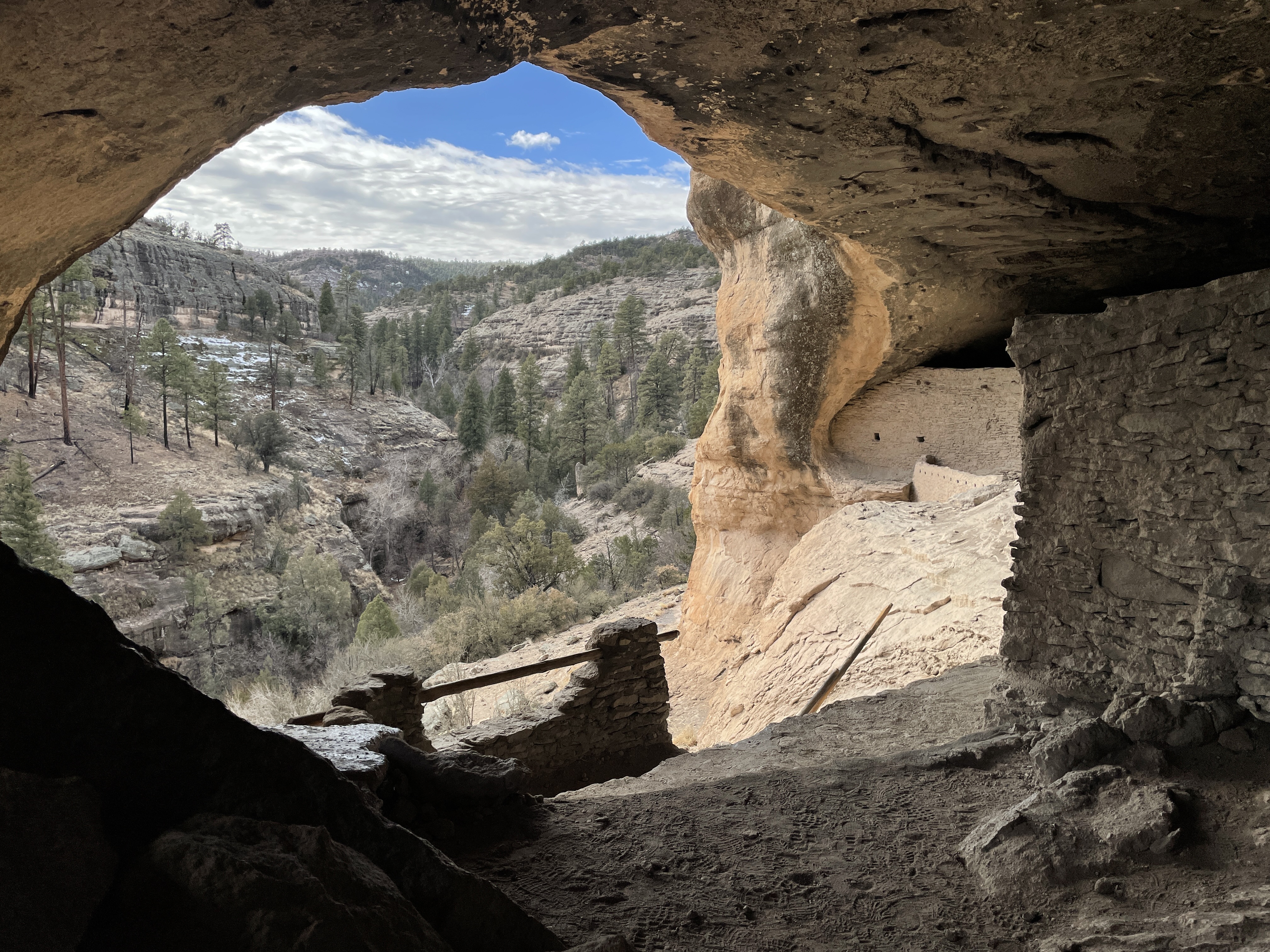
    Tucked deep within the mountains of southwestern New Mexico, Gila Cliff Dwellings National Monument preserves the remarkable remains of ancient homes built within natural caves. This companion guide to our First Encounters episode offers practical context, history, and planning information to help you prepare for your own first visit.

    Quick Facts

    • Location: Southwestern New Mexico, north of Silver City
    • Established: 1907
    • Preserved Resource: Cliff dwellings built by the Mogollon culture in the late 1200s
    • Setting: Surrounded by the Gila Wilderness, the nation’s first designated wilderness area
    • Entrance Fee: None

    Why Gila Cliff Dwellings Matter

    The cliff dwellings preserved here were home to people of the Mogollon culture for a short period in the late 13th century. Built within five natural caves above Cliff Dweller Creek, these rooms sheltered families, stored food, and formed a small community nested into a rugged landscape.

    Unlike many Southwestern archaeological sites, Gila’s dwellings are not set in an arid desert environment. Instead, they sit within a wooded canyon, part of a mountain ecosystem that offered water, game, and plant resources.

    Visiting the Cliff Dwellings

    The paved road into Gila Cliff Dwellings National Monument winds through the Gila National Forest before ending at the trailhead for the Cliff Dwelling Trail. From there, a short but moderately steep loop trail leads visitors up into the canyon and directly into the caves.

    • Trail Length: About 1 mile round trip
    • Elevation Change: Approximately 180 feet
    • Access: Ladders and uneven stone steps are required to enter the dwellings

    Once inside, visitors can walk through the rooms and look out across the canyon much as the original occupants once did.

    Know Before You Go

    • Cell service is extremely limited or nonexistent
    • Summer temperatures can be warm, even in the mountains
    • Afternoon thunderstorms are common during monsoon season
    • The trail includes ladders and narrow passages that may be challenging for some visitors

    The Gila Wilderness Connection

    Gila Cliff Dwellings National Monument is uniquely situated inside the Gila Wilderness, the first area in the United States formally designated as wilderness. This setting shapes the experience of visiting the monument, giving it a sense of remoteness that feels increasingly rare.

    Visitors often combine a stop at the monument with hiking, camping, or scenic drives in the surrounding national forest.

    Visitor Center & Nearby Camping

    A joint National Park Service and U.S. Forest Service visitor center sits near the entrance to the monument, offering orientation, exhibits, and a small bookstore.

    Several Forest Service campgrounds are located nearby along the creek, making it easy to turn a visit into an overnight stay.

    Further Exploration

    First Encounters Video

Verified by MonsterInsights